If your garden slopes or drops away in awkward levels, these terraced garden ideas will help you turn that gradient into a series of smart, usable spaces rather than a patch you avoid. Terracing is one of the most transformative things you can do outdoors: it carves a steep or uneven plot into flat, purposeful zones for dining, planting and play, held in place with retaining walls, steps and clever landscaping.
Over more than 25 years across Devon and the wider South West, our in-house team has reshaped hundreds of sloping gardens, and you can see a range of finished projects in our gallery.
Below we explain what a terraced garden is, how to plan and level a slope, and the design ideas our customers ask for most, from retaining walls and raised decking to steps, patios and planting.

A terraced garden is a sloping plot divided into two or more level tiers, each held in place by a retaining structure such as a wall, timber sleepers or gabion baskets. Instead of one steep, hard-to-use gradient, you get a set of flat spaces that step down or up the slope, linked by steps or paths. It is the classic way to make a hillside garden both safer and far more usable, turning an awkward drop into a striking, multi-level feature.
Because each tier is level, you can give it a clear purpose: a dining terrace nearest the house, a lawn or planting zone in the middle, and a quiet seating retreat at the far end. Good drainage matters on a reshaped slope, so permeable surfaces that let water soak away are worth choosing, in line with government guidance on permeable surfacing.

There are a few tried-and-tested ways to create level space on a slope, and most terraced gardens use a combination. The right approach depends on how steep your plot is, how much usable space you want, and your budget. Here is how the main methods compare:
| Method | What it involves | Best for |
|---|---|---|
| Retaining walls & terracing | Tiered levels held by sleepers, blockwork, stone or gabions | Turning a steep gradient into flat, usable zones |
| Raised decking | A level timber or composite platform built out over the slope | Reclaiming space quickly over a sharp or awkward drop |
| Cut and fill | Moving soil from the top of a section to build up the bottom | Gentle to moderate slopes on a tighter budget |
| Steps & pathways | Linking the levels with wide steps or a switchback path | Safe, comfortable access between tiers |
For anything beyond a gentle gradient, retaining walls and groundwork are a job for an experienced team rather than a weekend project, as they have to hold back a significant weight of soil safely.
Here are the terraced garden ideas we are asked for most, along with a few recent projects for inspiration. Have a look at the gallery, then explore the ideas below.


Retaining walls are the backbone of any terraced garden. Timber sleepers give a warm, natural look, while rendered blockwork or natural stone feels more contemporary or traditional to suit your home. Each wall holds back a level tier, and a well-planned run of terraces turns a steep bank into a sequence of usable outdoor rooms.

Where a slope drops away sharply, a level deck is often the quickest way to reclaim usable space, building out over the gradient to create a flat platform for seating or dining with a view. Composite and timber both work well, and our Raised Decking Ideas show just how effective a raised deck can be on an elevated or sloping plot.

Steps and paths tie the levels together and make a terraced garden safe and easy to move through. Wide, shallow steps feel comfortable underfoot, while a winding or switchback path takes the sting out of a steep climb. Matching resin steps and resin bound pathways give a seamless, low-maintenance finish that connects the tiers.

Every terraced garden needs at least one proper patio to sit and dine on. A smooth, permeable resin patio makes an ideal terrace surface, and adding shade with a pergola makes a level a place you will actually use, as our Garden Pergola Ideas explain.
Planting does more than soften a terraced garden; on the banks between tiers it helps to lock the soil in place and prevent erosion. Good choices for holding a slope include:
A patch of artificial grass on a level tier gives a neat, mow-free lawn, and for seasonal colour our guide to the Best Plants For Autumn Colour works well in raised beds and containers.
Even a compact slope can become a beautiful multi-level space. Keep the palette simple, use one or two tiers rather than many, and let a single surface flow between the levels. Our guides to Small Garden Ideas and Courtyard Garden Ideas are full of compact, level-friendly designs.
We have transformed gardens of all kinds right across Devon, Cornwall, Dorset and Somerset, from levelling and resin surfacing to full garden landscaping, blending practical groundwork with planting our customers love.
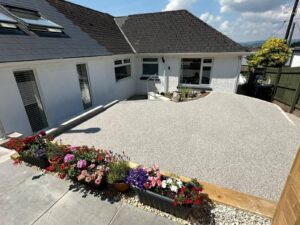
Here we finished a levelled garden with a smooth Moonlight Frost resin bound patio, giving a clean, low-maintenance terrace to relax and dine on. See the full Moonlight Frost Resin Bound Patio.

For this new-build plot we handled the full garden landscaping, shaping a bare, uneven developer space into defined, usable levels and surfaces. Take a look at the New Build Garden Landscaping Project.
You can browse more of our completed work on our case studies page.
If these terraced garden ideas have got you thinking, we would love to help you make the most of your slope. Our family-run team handles everything from the retaining walls and groundwork to the surfacing, steps and planting, so you get a safe, well-built terraced garden that looks the part and lasts. Whether you have a clear vision or just a tricky gradient you are not sure what to do with, we are happy to talk it through.
To book a free, no-obligation site visit, email us at info@outdoorhomeimprovements.co.uk or send us your details through our contact form, and one of our qualified surveyors, not salespeople, will be in touch.
Timber sleepers are usually the most cost-effective retaining option for lower tiers, and the cut-and-fill method reuses your own soil to create levels without importing materials. That said, taller or load-bearing walls need proper foundations and drainage, so it pays to get those right first time rather than rebuilding later.
Deep-rooted, low-maintenance plants that knit the soil together work best on a slope. Evergreen ground cover, ornamental grasses, lavender and low shrubs all help to stabilise banks while looking good year round, and climbers can be trained over retaining walls to soften them.
Terraced gardens are often overlooked from above or by neighbours, so privacy is worth planning in. Smart fencing, a pergola, trellis with climbers, or taller planting on the upper tiers all help to screen key seating areas without closing the space in.


