Choosing the right fencing for windy gardens makes the difference between a boundary that stands firm all winter and one that ends up flat on the lawn after the first big storm. Autumn is when the named storms start rolling in off the Atlantic, and exposed coastal and hilltop gardens across Devon and Cornwall take the brunt of it. If your fence has been leaning, rocking or losing panels, now is the time to plan a replacement built to cope. Our fencing team installs boundaries designed for exactly these conditions.
This guide explains which fence types handle wind best, why posts and fixings matter as much as the panels, and what you can do to stop a fence blowing down.
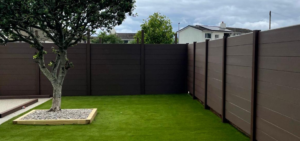
There is no single answer, because it depends on how exposed your garden is and how much privacy you want. As a rule, the fences that survive storms are the ones that are either strong enough to resist the wind or designed to let some of it pass through. A solid panel on weak posts acts like a sail, catching the full force of every gust until something gives.
For most exposed gardens, the strongest options are composite fencing on a metal or aluminium post system, well-built close board fencing on sturdy posts, and semi-open designs such as hit and miss or slatted fencing that reduce the pressure on the whole structure.
Here is how the most common fence types compare in an exposed garden:
| Fence type | Wind performance | Privacy | Maintenance |
|---|---|---|---|
| Composite fencing | Excellent, with a rigid post system | High | Very low |
| Close board fencing | Very good on strong posts | High | Moderate |
| Hit and miss fencing | Very good, lets wind filter through | Good | Moderate |
| Slatted fencing | Good, depending on gap size | Medium | Moderate |
| Lap or overlap panels | Poor in exposed sites | High | Moderate |
Cheap lap panels are the ones we replace most often after storms. They are light, thin and fixed into posts as a single sheet, so a strong gust can pop them out or snap the posts holding them.
Yes, composite is one of the best choices for an exposed site. The boards slot into a rigid aluminium or steel post system, so the whole fence works as one strong structure rather than a set of loose panels. It will not rot, warp or split, and it never needs painting or treating, which is a real advantage on the coast where salt air and rain take their toll on timber.
It costs more upfront than timber, but for second homes and holiday properties where nobody wants to be repairing fences between visits, composite fencing is often the most cost-effective choice over its lifetime.
If you prefer the look of timber, close board fencing is the strongest traditional option. Instead of prefabricated panels, it is built on site with vertical feather edge boards nailed to rails between each post. That makes it far more rigid than lap panels, and it can be stepped to follow sloping ground, which is common on Devon hillsides and coastal plots.
For a windy garden, the key is what holds it up. We use heavy-duty posts set deep in concrete, and on very exposed sites concrete posts or gravel boards can add extra strength and keep the timber clear of wet ground.

Most fences fail at the posts, not the panels. These are the changes that make the biggest difference:
In some gardens, a hedge or living boundary is a better answer than a fence altogether, because it filters wind rather than blocking it. Our guide Hedge or Fence? weighs up both options.
Yes. Slatted and hit and miss fences let air pass through the gaps, which lowers the pressure on the fence and calms the wind on the garden side. A solid barrier can create gusts and eddies just behind it, while a semi-permeable fence breaks the wind up more gently, which is better for both the fence and your planting. The trade-off is a little less privacy, so many clients use solid sections near seating areas and semi-open runs on the most exposed boundaries.
In most cases you can put up a fence of up to 2 metres high without planning permission, dropping to 1 metre next to a road or footpath used by vehicles. Different rules can apply to listed buildings and some new-build estates, so check the Planning Portal guidance on fences, gates and garden walls before you start. In windy spots, it is often better to stay a little lower and add planting for extra screening.
A new fence is also a good moment to look at the rest of the garden before the weather turns. Our checklist to Prepare Your Garden for Winter covers the other jobs worth doing now.
We install fencing across Devon and the South West, including some of the most exposed coastal sites in the region.
In Torbay, an existing customer’s boundary fence on an elevated coastal site had been pulled out of line by heavy ivy, rotted through and partly collapsed. Our team cleared the old fence and growth, set new posts along the sloping boundary and built new pressure treated close board fencing, stepped to follow the ground and taken right up to the wall of the house. Read the full Close Board Fencing Replacement in Torbay, or see more of our work in our case studies.

Composite fencing on a metal post system and well-built close board fencing on heavy-duty posts are the strongest options for most homes. The posts and how they are set matter just as much as the boards.
It varies. Many home insurance policies limit or exclude fences from storm cover, so check your policy wording. Building a fence properly in the first place is the best protection.
Fencing can be installed all year round. Replacing a weak fence in autumn, before the worst of the winter storms, avoids emergency repairs later.
If your fence has seen better days, or you are planning a new boundary on an exposed site, our in-house team can advise on the right fence type, posts and layout for your garden, and install it properly so it lasts.
To book a free, no-obligation site visit, email us at info@outdoorhomeimprovements.co.uk or send us your details through our contact form.


