These raised decking ideas show how the right decking can turn a sloping, awkward or elevated garden into level, usable space, and lift you up to a view worth showing off. A raised deck reclaims ground that a slope or a change in level would otherwise waste, creates a proper outdoor room, and, on the right plot, frames the outlook beautifully.
Below we cover the ideas that work best, how to choose between composite decking, timber decking and Millboard decking boards, the railings that keep it safe, and projects we have delivered for homes across Devon and the wider South West.
Raised decking is the answer whenever the ground is not doing what you want it to. Where a garden slopes, drops away or sits below the level of the house, a raised deck creates a flat, stable platform that connects straight to your back doors and turns dead gradient into usable space. Built in low-maintenance composite decking, natural timber decking or Millboard decking, it gives you a level surface where there was only slope before.
It also lifts you up. A deck raised even half a metre can clear a fence or hedge line and open up a view that was hidden at ground level, which is exactly why raised decking suits the elevated and coastal plots we see across the South West.
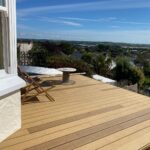

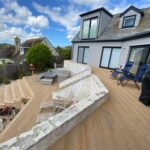
If your garden has an outlook worth enjoying, design the deck around it rather than as an afterthought. A few ideas that make the most of a view:
A raised deck is the most practical way to reclaim a sloping or uneven garden. Rather than the upheaval of excavating and retaining the whole slope, a properly engineered frame on solid footings creates a level surface above the gradient, with the space underneath left ventilated and free-draining.
The key is the structure beneath. Posts need firm concrete footings sized for the height and load, joists need correct spacing, and the whole frame needs designing for the slope and for our wet West Country weather. This is the part of a raised deck that is genuinely worth leaving to a professional, both for safety and so it lasts. Raised decks are part of our wider landscaping work, and we cover gardens right across Devon, from Torquay and Paignton to Plymouth.
The boards set the look, the upkeep and how the deck copes with an exposed spot. Here is how the main options compare:
| Decking Type | Best For | Maintenance Requirements |
|---|---|---|
| Composite | Low-maintenance, exposed and elevated decks | Occassional wash, no sealing or staining |
| Millboard | Grip and a natural timber look, splinter-free | Occassional wash |
| Treated Timber | A traditional, natural finish | Regular treating, sealing and sanding |
Composite decking is the popular choice for raised and exposed decks because it shrugs off sun, wind and rain without warping, fading or needing sealing. Millboard gives a strikingly natural look with excellent grip underfoot, and timber decking remains a lovely traditional option where you do not mind the upkeep.
Our guide to choosing the perfect composite decking goes into the detail if you are weighing them up.

Any deck more than 600mm above the ground needs a balustrade, and on a raised deck this is as much a design feature as a safety requirement. Glass panels keep a view open while protecting children and guests, while slimline metal or timber railings suit a more traditional look. For a deck built to show off a view, a frameless or low-profile glass balustrade is hard to beat.
Our guide to glass balustrades for decking explains the heights and fixings involved.
The space beneath a raised deck matters just as much as the surface. Done properly, it keeps the structure dry and the deck lasting longer. A good build-up is:
Avoid laying soil, bark or mulch under the deck, as these hold damp and attract pests. The void is also useful: it can be turned into discreet garden storage, and the open sides finished with timber or composite skirting or slatted screens to hide the frame, with a fine mesh behind to keep animals out while preserving airflow.
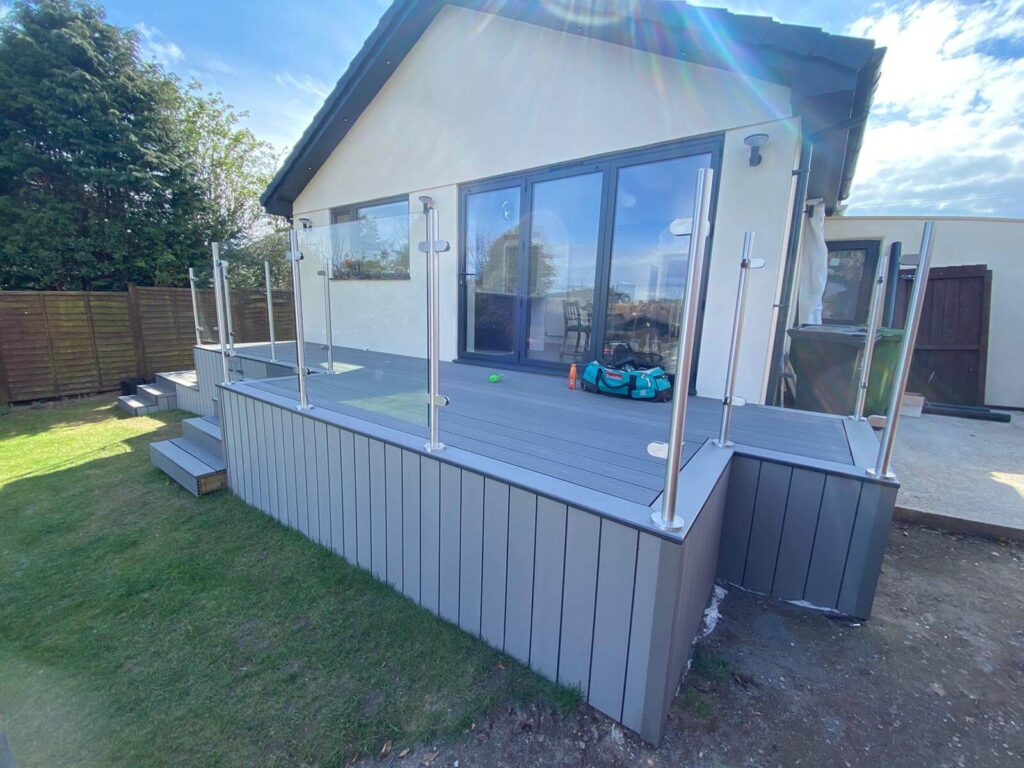
The details are what make a raised deck feel finished. Building the steps from the same boards gives a seamless transition between levels, and a non-slip finish keeps them safe in the wet. Recessed deck lights, post-cap lights and stair-riser lights all extend the evening and make a raised deck safer after dark.
Built-in benches and matching planters soften the edges and save on furniture, while a pergola or covered section adds shade and shelter so the deck works year-round. Slatted screens or fencing add privacy on exposed sides without closing the space in.
Take a look at just some of the many raised decking projects we have completed across Devon, Cornwall and Somerset.

A homeowner in Braunton, North Devon had an elevated space off the back of the house with far-reaching views across the town and countryside, but it was tired and underused. We built a secure, level sub-frame suited to the elevated position, then laid warm oak-toned composite decking across the full terrace with a neat raised step detail and matching cladding around the bay window.
The deck flows straight out from the patio doors and frames the view, and because composite was chosen for the exposed spot it stays slip-resistant and good-looking with no sealing or staining. You can read the full Braunton composite decking balcony case study for more.

For the owners of a Devon holiday home with views across the Moors, we built a wooden pergola over a composite decking seating area and added glass balustrades around the new seating space, so guests could take in the outlook safely without losing the view. Steps were built into the bank to make the most of the natural levels.
It is a great example of a raised deck designed around a view, with the glass balustrade doing the safety job without interrupting the outlook. Take a look at the full Devon holiday home makeover case study for the detail.
You can browse more of our completed work on our case studies page.
A raised deck is one of the most transformative things you can add to a sloping or elevated garden, turning wasted gradients into a level, usable space with a view to enjoy. Our family-run team designs and builds each deck around your garden, handling the structure, the surface, the steps and the safe edge as one complete project.
To book a free, no-obligation site visit, email us on info@outdoorhomeimprovements.co.uk or send us your details through our contact form and we will be happy to help.


