Some of the best garden privacy ideas do far more than block a view. The right screening turns an overlooked garden into a calm, private retreat you actually want to spend time in, whether that is shielding a patio from next door or stopping a coast path from peering in at a second home. A well-planned mix of garden fencing, planting and clever structures is the key.
This guide covers the main ways to add privacy, from fences and screens to hedges, pergolas and planting, plus what the rules say about how high you can go.

A private garden is simply nicer to use. You relax more easily when you are not on show, outdoor seating and hot tubs feel far more inviting, and screening can cut wind and noise at the same time.
It matters even more for holiday homes and coastal properties, where open outlooks often mean busy paths or neighbouring gardens looking straight in.
The trick is to screen at the right height and in the right place, rather than walling yourself in. Work out exactly where the overlooking comes from, at ground level or from upstairs windows, then layer your solutions to suit.
Most private gardens combine three things: a solid boundary such as a fence or hedge, targeted screening around seating areas, and a little height overhead where upstairs windows are the problem.
| Method | Privacy speed | Cost | Best for |
|---|---|---|---|
| Fencing and screens | Instant | Low to mid | Fast, defined boundaries |
| Hedging and trees | Slow to establish | Low | Natural, wildlife-friendly screens |
| Trellis and climbers | Fairly fast | Low | Extra height on a fence |
| Pergola or overhead | Instant | Mid to high | Blocking upstairs overlooking |
| Freestanding screens | Instant | Low to mid | Targeted seating-area privacy |
Fencing is the fastest route to instant privacy. Slatted or hit-and-miss panels filter wind while still blocking the view, and adding a trellis topper gains extra height without making a boundary feel oppressive.
Low-maintenance composite screens are ideal for exposed or coastal gardens, as they shrug off the weather and never need treating. For help deciding between a living or built boundary, see our guide on Hedge or Fence.
Planting softens hard boundaries and adds privacy that improves year after year. Evergreen hedges give a dense, natural screen, while a well-placed small tree or a row of pleached trees can block an upstairs sightline without stealing all your light.
Climbers trained up a trellis or wires are a quick win too, greening a fence or wall in a single season.
When the overlooking comes from above, the answer is height rather than a taller fence. A pergola, gazebo or slatted overhead beam breaks the line of sight from upstairs windows and instantly makes a seating area feel enclosed.
Add a canopy, climbing plants or adjustable slats and you gain shade and shelter as well as privacy. Our Garden Pergola Ideas guide has more inspiration.
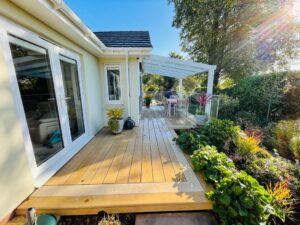
If a fence is not right for you, there are plenty of alternatives that create privacy with a softer, greener feel:
Many gardens work best with a combination, for example a low fence topped with trellis and climbers, which keeps costs down while still doing the job.
In a small garden you rarely need to screen the whole boundary, just the spot where you sit. A pair of slatted screens or a corner pergola around the seating area gives instant seclusion without closing in the whole space.
Screening only where it counts keeps a compact garden feeling open and bright while still giving you a private corner.
There is no absolute legal right to privacy in a garden, but height rules shape what you can build. As a general guide, a fence or wall can be up to two metres high without planning permission, or one metre next to a road, and tall evergreen hedges are covered by separate high hedges rules.
You can check the detail in the Planning Portal guidance on fences, and it is always worth a quick word with neighbours before screening a shared boundary. A considered landscaping plan keeps everything within the rules.
We install privacy fencing, screens and full garden schemes across the South West.
In Torbay, we replaced tired, failing panels with smart new close board fencing that gave the garden a secure, private boundary built to last. See the full Torbay fencing project, or browse more work in our case studies. We also offer full landscaping in Devon.

Identify where the overlooking comes from, then layer your screening. A fence or hedge handles ground-level views, targeted screens cover seating areas, and a pergola or tall planting deals with upstairs windows.
Evergreen hedges, freestanding slatted screens, planted trellis, tall grasses in raised beds and pergolas all add privacy with a softer look. A combination often works best.
There is no absolute right to privacy, but you can screen your garden within the height rules, generally up to two metres for a fence or wall. High hedges have their own rules, so check locally before going tall.
A low fence topped with trellis and fast-growing climbers, or a couple of screens around the seating area, gives good privacy for less than screening an entire boundary in one go.
Whether you need new fencing, stylish screens, a pergola or a full planting scheme, we can design and build a garden that feels properly private and looks great. From single boundaries to complete transformations, our team handles it all.
Get in touch through our contact page or email us at info@outdoorhomeimprovements.co.uk to arrange a site visit.


